Szerj Systemsszerj.systems
Printed from szerj.systems · Digital systems for founder-led businesses · contact@szerj.systems
A website that makes the offer obvious, shows the work behind it, and gives a buyer one clear way to get in touch. If there is nothing built yet, that gets built. If there is a site already, the same three things are what it gets rebuilt around.
You do not need a website to start. If there is one, we read it first; if there is not, there is nothing to read and the work begins by understanding the business instead.
Someone looking for your service may spend only seconds deciding whether you look like the right call. That decision is made on the first screen, and it is lost there — not because the site is ugly, but because the visitor cannot tell what is on offer, cannot find anything that proves the work is good, and has to hunt for the way to ask.
The homepage says what you are called before it says what you do
Service pages exist but read as the same paragraph with the noun swapped
The proof — photos, reviews, finished work — is somewhere further down, or nowhere
Getting in touch means finding a form on another page
Each line below is something the work produces. None of them is a promise about how much more business follows — that depends on demand, on the market and on what you sell, and a website does not manufacture any of the three.
The service is legible on the first screen, on a phone
Each service has a page that answers what a buyer actually asks before calling
Proof appears where the decision is made, not after it
One consistent way to get in touch, on every page
Inquiries are tracked, so you can see where they came from
Scope is set by what the business actually needs, so this is the shape of the work rather than a fixed package. The second column is the part most pages leave out.
Page structure and the site map behind it
Service framing and the copy for the core pages
Design and build, mobile first
The inquiry path — form, phone, or both — and its tracking
On-page search structure: titles, headings, schema, internal links
Deployment, and the legal and trust pages a real business needs
Ongoing content marketing or blog production
Paid advertising management
Link-building campaigns
Anything that promises a search ranking
Three businesses with no site of their own. Each one got a website built around what it sells, and a clear path from seeing the work to getting in touch.
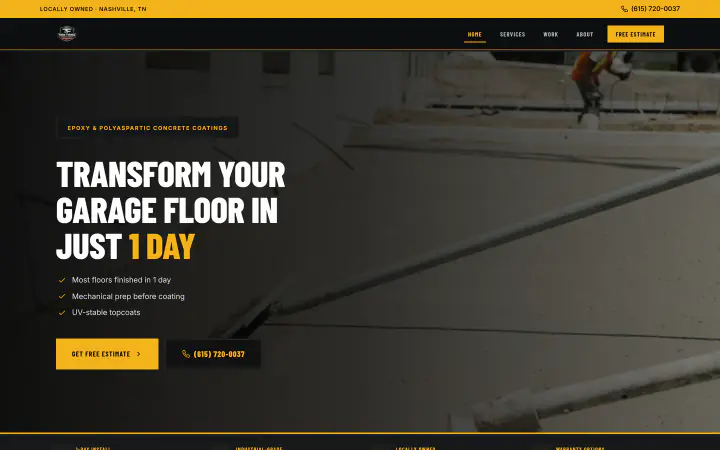
True Finish had no brand and no website. We built both, plus the quote path buyers use to reach them and the tracking that shows where each quote request came from.
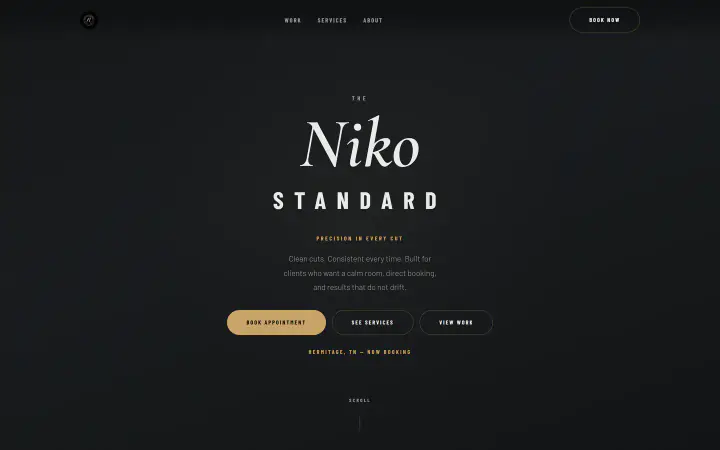
Niko was running on Booksy and word of mouth, with no site and no identity of his own. Now there is a full visual identity, a custom site, and a booking path built around the standard of the work.

Holy Nguyen had an established brand and no website. Now the photography and motion work lives in a structured archive, with a clear path from seeing it to booking a shoot.
This studio runs one sequence. What changes between one engagement and the next is how much happens in each stage — not the stages, and not their order.
What you sell, who buys it, what they compare you against, and what already exists — photographs, reviews, a logo, a site.
Which services get their own page, what each page is for, and what a visitor has to believe before they will call.
The site map, the page structure, and where proof and the inquiry path sit inside it.
Design and build, on a phone first, then everything else.
The inquiry path is tested end to end and its tracking is confirmed working before launch.
Three things have to be true before someone gets in touch: the service they want is obvious, the proof is concrete, and asking takes one tap. When a site is not producing inquiries, the one that is missing is rarely the visual design.
The pages closest to this one. Same kind of question, different answer.
When replacing a site is the right call, and when it is not.
One page, one offer, built for traffic you are paying for.
Nashville-area local service businesses with a real offer — contractors, home services, clinics, professional services — that need the website to explain what they do, show that they are good at it, and make getting in touch easy.
Both, and neither is the default. A business with no site and a business replacing one are equally normal here. What differs is the first week: where a site already exists we read it before proposing anything, and where one does not there is nothing to read, so the same understanding comes from talking about the business instead.
It depends which engagement the work becomes. A website on its own is a Focused Digital Build; a website with the brand and the supporting pieces settled at the same time is a Complete Digital System, and the two have different delivery windows. Both are published on the Services page, and you get a specific date range in writing before anything is committed.
Engagements are scoped per business — a single-service contractor with five pages is not the same build as a multi-location clinic. You get a written scope and a price before any work begins. It is not a fit for a five-hundred-dollar template install.
No. Copy for the homepage, the core service pages and the calls to action is part of the work. We interview you for the inputs — the offer, the audience, the objections, the proof — and write the pages for you to review. If you already have a writer you trust, that works too.
The on-page part, yes: titles, headings, schema, internal links, and consistent business details that match your Google Business Profile. Off-page SEO and link-building campaigns are separate, and we will tell you plainly whether you need one.
You do not need a website to start. If there is one, we read it first; if there is not, there is nothing to read and the work begins by understanding the business instead.