Szerj Systemsszerj.systems
Printed from szerj.systems · Systems architecture for service businesses · contact@szerj.systems
Local search works better when the website is clear about what you do, where you do it, and how to reach you. This is the website half of that — the structure, the pages and the markup that make a business legible to both a nearby buyer and the systems that surface it.
There does not have to be a site yet. Where one exists, this is a correction to its structure; where one is being built, the same structure is built in from the start — which is the cheaper of the two.
A business can be findable and still be hard to choose. Nearby buyers arrive from a map listing or a search result and land on a site that lists services differently from the profile, is vague about which areas are actually served, and gives no obvious way to ask.
The services on the site and the services on the profile do not match
One page tries to cover every service and every town
Address, phone number and business name are written differently in different places
There is no page for the service someone actually searched for
Each line below is something the work produces. None of them is a promise about how much more business follows — that depends on demand, on the market and on what you sell, and a website does not manufacture any of the three.
One page per service that a buyer would search for by name
Service-area coverage stated honestly, and only where you actually work
The same business details everywhere, matching the Google Business Profile
Structured markup so the services and the area are machine-readable
A clear way to get in touch from every one of those pages
Scope is set by what the business actually needs, so this is the shape of the work rather than a fixed package. The second column is the part most pages leave out.
Service page structure, one job per page
Service-area page structure, where the areas are genuinely served
Consistent name, address and phone details across the site
LocalBusiness, Service and FAQ markup generated from the page's own content
Internal links, so a buyer and a crawler can both get from the area to the service
Link building and outreach campaigns
Review generation or review-gating schemes
Directory submission packages
Pages for towns you do not actually serve
Any promise about a ranking position
Two local service businesses, each with a site of its own rather than a profile on someone else's platform.

True Finish had no brand and no website. We built both, plus the quote path buyers use to reach them and the tracking that shows where each quote request came from.
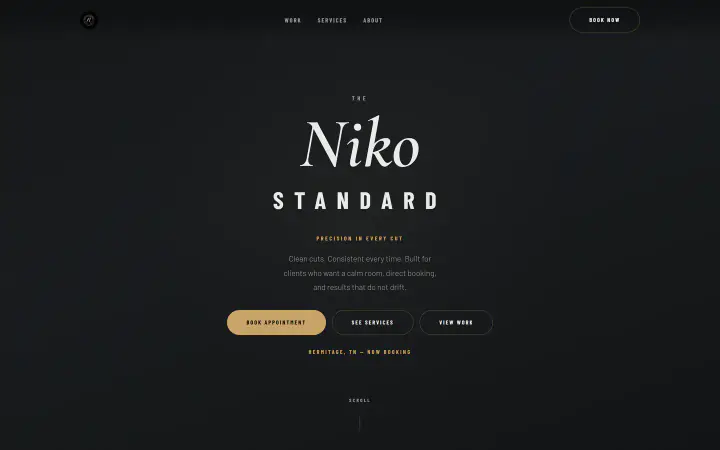
Niko was running on Booksy and word of mouth, with no site and no identity of his own. Now there is a full visual identity, a custom site, and a booking path built around the standard of the work.
This studio runs one sequence. What changes between one engagement and the next is how much happens in each stage — not the stages, and not their order.
What you actually sell, where you actually work, and what the profile and any existing pages currently claim.
Which services deserve their own page, and which areas can be claimed honestly.
The page structure, the internal links between service and area, and the markup each page will emit.
The pages, the details and the markup, generated from the page's own content.
Markup validated, business details checked against the profile, and every new page reachable from the site's own navigation.
The profile, the service page and the area page make the same promise in the same words, so a buyer never has to reconcile two versions of the business.
The pages closest to this one. Same kind of question, different answer.
Getting the Google Business Profile right, and keeping it right.
Being quotable by ChatGPT, Perplexity and Google's AI answers.
The profile helps people find you. The website is where they decide. A profile with no site behind it means a buyer comparing three providers has less to go on for you than for the other two.
Clear service pages, honest service-area coverage, business details that match your profile exactly, fast mobile pages, and direct answers to the questions local buyers already ask. Structure and consistency do more than keyword density.
No. Anyone who guarantees a ranking is either guessing or describing something they do not control. What this work does is remove the reasons a business is hard to understand and hard to verify, which is the part of local search that is actually in your hands.
No. Pages for areas you do not really serve are thin, they do not convert, and they are the pattern search engines are most practised at ignoring. Make a page where you genuinely work and can say something specific about working there.
There does not have to be a site yet. Where one exists, this is a correction to its structure; where one is being built, the same structure is built in from the start — which is the cheaper of the two.