Szerj Systemsszerj.systems
Printed from szerj.systems · Digital systems for founder-led businesses · contact@szerj.systems
Ask ChatGPT, Perplexity or Google's AI answers for a provider in your category, and the reply may name your competitors and not you. AI Search Visibility is making your business clear enough for those tools to understand and quote. The technical name is Generative Engine Optimization (GEO): restructuring your content, your business details and the schema behind them so your services, your area and your proof can be read directly, not just seen.
Where a site exists, this restructures it. Where one is being built, the same structure is built in from the start — which is both cheaper and more complete than adding it afterwards.
AI tools build an answer from facts they can pull straight out of a page. A page that reads perfectly well to a person but gives them nothing clear to pull out — no plain statement of who the business is, no structured list of services, no direct answers to buyers' questions — gets passed over in favour of a worse business with a clearer site.
Asking ChatGPT or Perplexity for a provider in your category returns competitors and not you
The site has no structured markup, or markup written separately from the page
Services and areas are described in prose and nowhere else
The questions buyers actually ask are answered on the phone and not on the site
Each line below is something the work produces. None of them is a promise about how much more business follows — that depends on demand, on the market and on what you sell, and a website does not manufacture any of the three.
A clear statement of what the business is, what it does and where — the business "entity" AI tools look for
Services and service areas in a structure a machine can read
The questions buyers ask, answered on the page and in the markup from one source
Proof stated in a form that can be quoted
A recheck afterwards, so visibility becomes something you look at rather than assume
Scope is set by what the business actually needs, so this is the shape of the work rather than a fixed package. The second column is the part most pages leave out.
A visibility read across ChatGPT, Perplexity, Gemini and Google's AI Overviews for your category and area
Content restructured so services, areas, proof and answers are extractable
FAQPage, LocalBusiness and Service markup generated from the page's own content
Entity consistency across the site and the profiles that reference it
A recheck after the work, documenting where the business now appears
Any guarantee of citation — no engine offers one, and none can be bought
Content written for engines rather than for readers
Fabricated statistics, credentials or awards to make a page look more quotable
Ongoing content production
Structure is what a machine reads. One of these publishes its work as a categorised archive rather than a gallery; the other had its metadata and accessibility brought up to standard before launch.

Holy Nguyen had an established brand and no website. Now the photography and motion work lives in a structured archive, with a clear path from seeing it to booking a shoot.
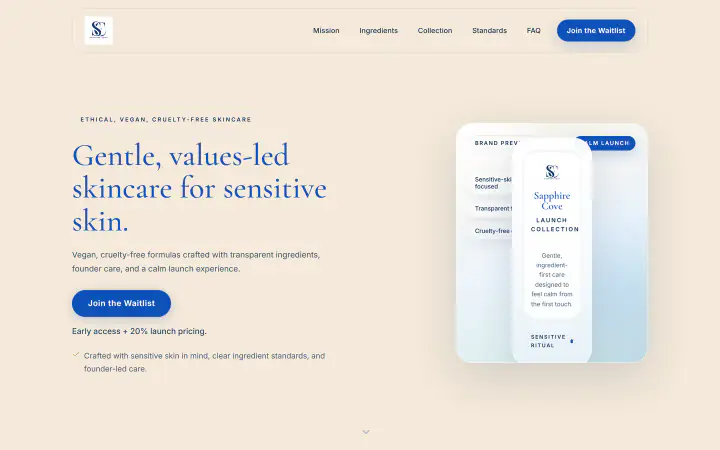
Sapphire Cove came to us pre-launch, with no brand and no site. This phase unified the signup path, hardened the forms against spam and abuse, and brought accessibility and metadata up to a standard the brand could launch on.
This studio runs one sequence. What changes between one engagement and the next is how much happens in each stage — not the stages, and not their order.
How the business currently appears — or does not — when the four engines are asked for a provider in your category and area.
The entity: what the business is, what it sells, where, and what backs it.
The structure that makes those facts extractable, and the markup that carries them.
The content and the markup, generated from one source so they cannot drift.
A recheck across the same four engines, with what changed written down.
An engine assembles an answer from what it can extract. A polished page that cannot be parsed is skipped in favour of a plainer one that can, which makes this a content-architecture problem rather than a design one.
The pages closest to this one. Same kind of question, different answer.
How a site earns its place in local results rather than buying it.
Getting the Google Business Profile right, and keeping it right.
It is the technical name for AI Search Visibility: structuring a website so AI search engines — ChatGPT, Perplexity, Gemini and Google's AI Overviews — can read, cite and recommend the business when someone asks. It works through content architecture, entity signals and schema rather than through keywords or backlinks.
Traditional SEO optimizes for a ranked link in a list. GEO optimizes for being cited inside a generated answer, where there is no list. They share technical foundations — clean content, valid schema — and the thing being measured is different: a position versus a citation.
ChatGPT, Perplexity, Gemini and Google's AI Overviews. The read covers all four, and the work prioritizes what they have in common — clear entity definitions, structured services and areas, answerable questions, and proof that can be quoted — so one architecture serves the set.
It depends on the engine, and nobody controls it. These systems re-crawl and refresh on their own cadences, so the honest answer is that the work makes a business citable and then the recheck reports what actually happened, rather than a date being promised in advance.
No. It is added alongside. Local buyers still search directly, and the Google Business Profile and on-page SEO still drive most discovery today.
Not always. Sometimes the site needs schema added and its answers restructured. Sometimes the content itself is too thin for an engine to extract anything from, and no amount of markup fixes that. The read at the start says which, in writing, before anything is committed.
Where a site exists, this restructures it. Where one is being built, the same structure is built in from the start — which is both cheaper and more complete than adding it afterwards.