Szerj Systemsszerj.systems
Printed from szerj.systems · Digital systems for founder-led businesses · contact@szerj.systems
For businesses where people are already arriving and not enough of them are getting in touch. The work is on the pages that matter most: what they say, when the proof appears, and how much a visitor is asked to commit before anyone has earned it.
This work needs a live site with people arriving on it. That is not a rule about the kind of business — it is that a conversion rate needs visitors to be a rate at all. Without traffic yet, the useful work is building the thing and the measurement first.
A conversion rate optimization (CRO) review: tell us the pages and what the analytics show. Faster than a general enquiry if the pages are already known.
The traffic is fine and the phone is not ringing enough. That gap is almost never one broken thing; it is a page that buries what the visitor came for, proof that arrives after the decision has already been made, or a form that asks for more than the visitor is ready to give.
Analytics show people reaching the service page and leaving it
The form asks for detail before the visitor knows whether you can help
The proof is on a different page from the decision
Two or three different calls to action compete on the same screen
Each line below is something the work produces. None of them is a promise about how much more business follows — that depends on demand, on the market and on what you sell, and a website does not manufacture any of the three.
Each priority page has one job, and says it in the first screen
Proof moves to where the hesitation is
The form asks for what is actually needed to start a conversation
One call to action per page, in a predictable place
Enough measurement in place that the next change can be judged
Scope is set by what the business actually needs, so this is the shape of the work rather than a fixed package. The second column is the part most pages leave out.
A read of the pages with the most to gain, using what the analytics already show
Page-by-page recommendations in priority order
Rewritten page messaging and call-to-action structure where that is the fix
Form and inquiry-path changes
The tracking needed to tell afterwards whether anything moved
Traffic acquisition — this work does not bring more visitors
A full redesign, unless the read establishes that the structure is the problem
Split testing at volumes where the result would not be readable
Any promised percentage improvement
The inquiry paths themselves, built and live: a contractor's quote path with attribution on it, and a pre-launch signup path hardened against automated submissions.
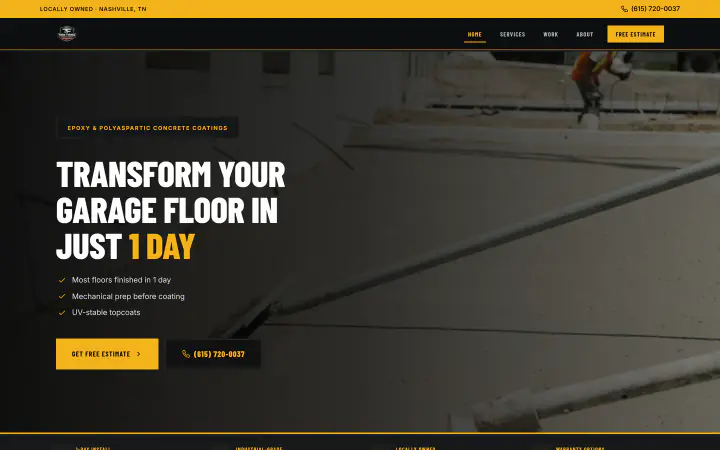
True Finish had no brand and no website. We built both, plus the quote path buyers use to reach them and the tracking that shows where each quote request came from.

Sapphire Cove came to us pre-launch, with no brand and no site. This phase unified the signup path, hardened the forms against spam and abuse, and brought accessibility and metadata up to a standard the brand could launch on.
This studio runs one sequence. What changes between one engagement and the next is how much happens in each stage — not the stages, and not their order.
What the analytics and the inbox already show about where people stop, read against the pages themselves.
Which pages are worth the work, and what each one has to do.
The order of the fixes, cheapest and highest-value first.
The page, copy and form changes themselves.
Tracking confirmed before and after, so the change can be read rather than assumed.
Find where confidence drops: a call to action that arrives before the reader is ready, proof that lands after the decision, or a form asking for commitment nobody has earned yet.
The pages closest to this one. Same kind of question, different answer.
A structured read of the current site before anything is changed.
Page messaging, where the proof sits, how many calls to action compete on a screen, how much the form asks for, and the order the reader meets things in. Rarely the visual design, and never for its own sake.
Yes. SEO is about the right people reaching the page. This is about more of them getting in touch once they have. They are complementary and they are not substitutes — improving a conversion rate on a page nobody visits changes nothing.
Yes, for this specific work. A conversion rate needs visitors to be a rate. If the site is new or barely visited, the useful work is building it properly with measurement in place, and that is a different engagement rather than a smaller version of this one.
No, and neither can anyone else honestly. What you get is a prioritized set of changes with a stated reason for each, and enough measurement that the effect is readable rather than argued about.
This work needs a live site with people arriving on it. That is not a rule about the kind of business — it is that a conversion rate needs visitors to be a rate at all. Without traffic yet, the useful work is building the thing and the measurement first.
A conversion rate optimization (CRO) review: tell us the pages and what the analytics show. Faster than a general enquiry if the pages are already known.