Szerj Systemsszerj.systems
Printed from szerj.systems · Digital systems for founder-led businesses · contact@szerj.systems
A landing page works when the offer is specific, the reader's problem is named, and the next step matches what they were promised on the way in. These are built as one uninterrupted path, not as a smaller version of the homepage.
A landing page can be the first thing a business has online, or the tenth. What it needs is one defined offer and a source of traffic to point at it — not an existing website.
One offer, one traffic source, one goal. Tell us those three and the plan comes back scoped.
Paid traffic arrives with an expectation set by the ad. A page that then offers six services, three calls to action and a company history spends that expectation on navigation. The click has already been paid for by the time the page starts negotiating.
The ad promises one thing and the page opens with the full service menu
There is a header full of links inviting the visitor to leave
The form is at the bottom, and only at the bottom
Nobody can say which campaign produced which inquiry
Each line below is something the work produces. None of them is a promise about how much more business follows — that depends on demand, on the market and on what you sell, and a website does not manufacture any of the three.
One offer, named in the same words as the ad that brought them
The reader's problem stated before the pitch
Proof placed where the hesitation is, not at the end
One way to act, repeated down the page
Campaign-level tracking, so spend can be judged against inquiries
Scope is set by what the business actually needs, so this is the shape of the work rather than a fixed package. The second column is the part most pages leave out.
One page built around one conversion goal
Offer framing and the copy for it
Form or call structure, and the friction decisions behind it
Trust and proof placement
Conversion tracking wired to the traffic source
Campaign management or ad spend
Using landing pages as a substitute for real service pages
Doorway pages for towns or keywords with nothing specific to say
Guaranteed cost per lead
Two inquiry paths, built and running: a contractor's quote request, and a pre-launch signup flow hardened against automated submissions.
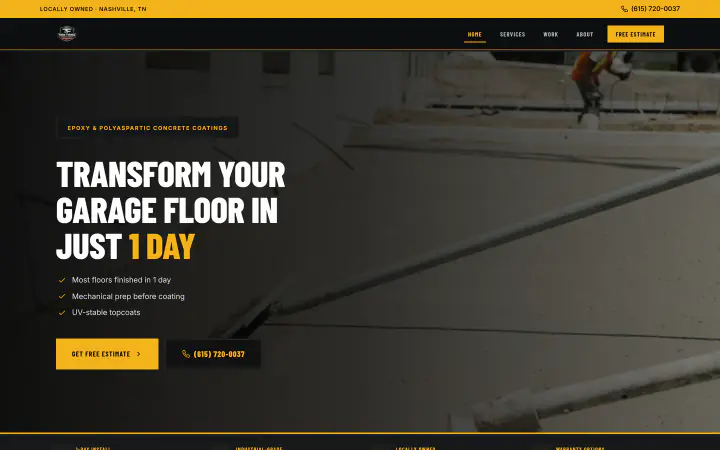
True Finish had no brand and no website. We built both, plus the quote path buyers use to reach them and the tracking that shows where each quote request came from.
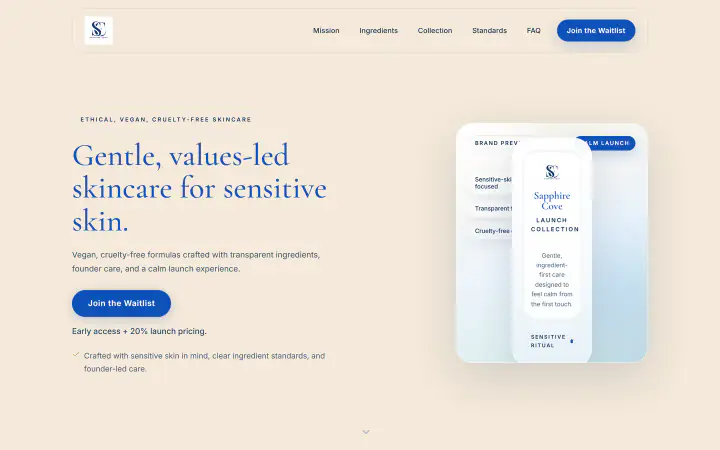
Sapphire Cove came to us pre-launch, with no brand and no site. This phase unified the signup path, hardened the forms against spam and abuse, and brought accessibility and metadata up to a standard the brand could launch on.
This studio runs one sequence. What changes between one engagement and the next is how much happens in each stage — not the stages, and not their order.
The offer, the traffic source, and what the ad is promising.
The single conversion goal, and what a reader must believe to reach it.
The order of the page: problem, offer, proof, action.
The page, the copy and the form.
Conversion tracking confirmed against the traffic source before spend starts.
A landing page has no navigation to fall back on. The problem, the proof and the action all have to fit inside one uninterrupted read.
The pages closest to this one. Same kind of question, different answer.
What a new site for a local service business actually has to do.
When replacing a site is the right call, and when it is not.
When there is one focused goal and a specific source of traffic — a campaign, a season, a single offer. A service page has to serve everybody who arrives from anywhere; a landing page only has to serve the people who clicked one thing.
Sometimes, if it is genuinely useful, specific, and properly linked into the rest of the site. It is a poor substitute for real service pages, and a set of near-identical pages built for keywords rather than for readers is the pattern search engines handle worst.
No. This work is the page and its measurement. We will make sure the tracking lines up with whoever is running the traffic, so the two halves can be judged together.
A landing page can be the first thing a business has online, or the tenth. What it needs is one defined offer and a source of traffic to point at it — not an existing website.
One offer, one traffic source, one goal. Tell us those three and the plan comes back scoped.